
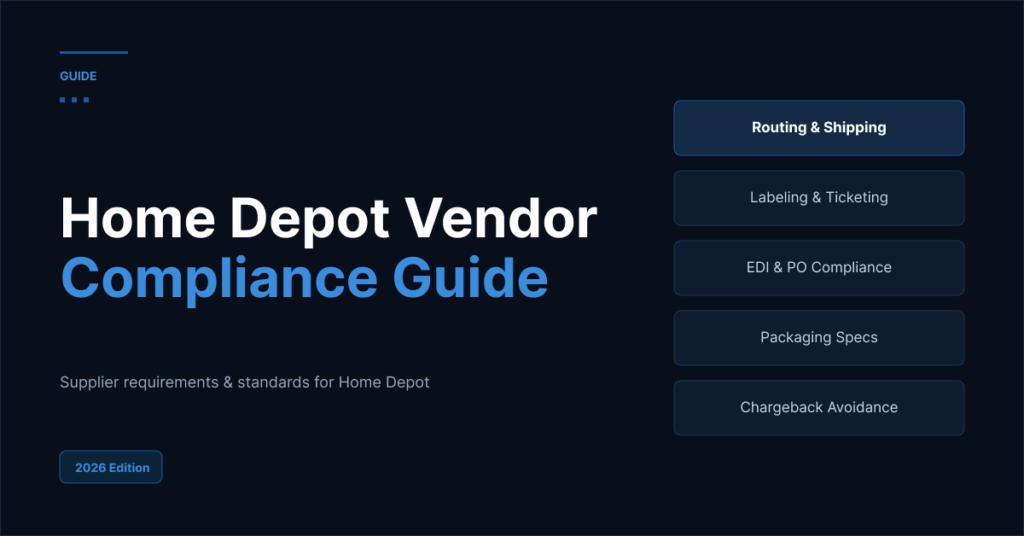

Home Depot is the world’s largest home improvement retailer, with more than 2,300 stores across North America and a distribution network built for high-volume, high-velocity fulfillment. For suppliers, getting on the shelf is a significant opportunity. Staying there requires consistent operational execution against some of the most detailed compliance standards in retail.
The right 3PL partner is not optional for most Home Depot suppliers. It is the operational foundation that determines whether you hit fill rate targets, avoid chargebacks, and maintain the vendor scorecard performance that keeps your buyer relationship intact.
This guide covers what Home Depot actually requires from suppliers, where compliance failures most commonly occur, and what to look for in a 3PL before committing.
How Home Depot’s Distribution Network Works
Before evaluating a 3PL, it helps to understand how Home Depot moves product. Their inbound supply chain routes through several distinct facility types, each with its own operational requirements.
Rapid Distribution Centers (RDCs) are the primary inbound node for most suppliers. Merchandise flows from the RDC to individual stores. Stocking Distribution Centers (SDCs) and Bulk Distribution Centers (BDCs) handle longer-term inventory storage, with BDCs focused on oversized and heavy items. Direct Fulfillment Centers (DFCs) support eCommerce orders and stock an extended product assortment beyond what stores carry. Flatbed Distribution Centers (FDCs) are purpose-built for the Pro customer segment, fulfilling large job-site orders for lumber, concrete, roofing materials, and similar categories.
Where your products route depends on category, size, and whether your POs are tied to store replenishment or eCommerce demand. A 3PL that understands this structure will configure your fulfillment operation accordingly. One that does not will create compliance exposure from the start.
Home Depot’s Core Compliance Requirements
Routing Guide Adherence
Home Depot’s routing guide governs how collect shipments must be transported to their DCs. It specifies approved carriers, pallet configuration standards, load requirements by DC type, and booking procedures through their Transportation Management System (TMS). When shipping multiple POs to the same RDC on the same day, suppliers must consolidate under a single PRO/BOL with a master bill of lading. Non-compliance carries a $75 offset per violation.
Routing guide requirements are updated periodically. Suppliers and their 3PL partners should be pulling the current version from the Supplier Hub before every shipping season, not relying on institutional memory from the last vendor guide they reviewed.
EDI Requirements
Home Depot requires standard EDI transaction sets: the 850 (purchase order), 855 (PO acknowledgment), 856 (advance ship notice), and 810 (invoice). EDI setup must be tested and validated before the first live PO ships.
The EDI 856 ASN carries particularly high stakes. Home Depot requires the ASN to be transmitted after the shipment departs the supplier facility and before it arrives at the DC. The ASN must include the correct TMS shipment ID and carton-level accuracy. A missing ASN triggers a $1,000 offset per occurrence. A late ASN carries a $250 offset. Home Depot holds suppliers to a 100% accuracy threshold on ASN timeliness.
A 3PL with existing Home Depot EDI connections and validated label templates can typically complete setup in two to four weeks. Without that infrastructure in place, setup takes six to eight weeks or more, which can delay first-shipment timelines significantly.
GS1-128 Labeling
Home Depot enforces GS1-compliant labeling on all cartons and pallets through automated scanning at their distribution centers. Non-compliant labels cause receiving failures at the DC, which generate chargebacks and misalign your inventory records.
Carton labels must include the PO number, vendor number, SKU, and GTIN, printed at ANSI Grade B quality or higher, and placed on the correct face of the carton per Home Depot specifications. Each pallet must carry a GS1-compliant pallet label with a unique SSCC barcode, placed on two adjacent sides. Mixed-SKU pallets require specific configuration per the routing guide.
Labeling errors are among the most common chargeback triggers for new Home Depot vendors. A 3PL that generates labels programmatically through their WMS, rather than manually, significantly reduces this risk.
Fill Rate
Home Depot holds suppliers to a 98% fill rate threshold. If received quantities fall below the PO quantities ordered, the shortfall is subject to a 10% offset on the value of items not received. Fill rate performance is tracked at the SKU level, so partial shipments on individual line items count against you even if overall shipment volume looks adequate.
Inventory accuracy inside the 3PL’s warehouse is the first line of defense against fill rate failures. Suppliers with shared inventory across retail and DTC channels need channel-level allocation logic inside the WMS to prevent retail POs from being short-shipped due to DTC order pull.
Supplier Expectation Rating (SER)
The SER is Home Depot’s supplier performance scorecard. It tracks compliance across on-time delivery, fill rate, labeling accuracy, ASN timeliness, routing compliance, and PO accuracy. SER scores are reviewed by buyer teams and directly influence future PO volume.
Suppliers with SER scores below 95% face increased scrutiny, more frequent audits, and risk to their shelf position. Maintaining a strong SER score is not a separate initiative from good day-to-day fulfillment operations. It is the result of getting the basics right consistently.
What to Look for in a Home Depot 3PL
Not every 3PL has the operational infrastructure to support a retail account with Home Depot’s compliance requirements. Here is what to evaluate before choosing a partner.
Home Depot EDI connections already in place. Starting the EDI build from scratch adds weeks to your onboarding timeline. Ask whether the provider has existing, validated EDI connections with Home Depot.
WMS-integrated label generation. Labels should be generated programmatically from the WMS using current Home Depot templates, not produced manually or maintained in spreadsheets. Ask to see the label generation workflow.
Routing guide expertise. The 3PL’s operations team should be actively managing against the current Home Depot routing guide, not relying on a past version. Ask who owns routing guide updates and how frequently they review them.
Retail fulfillment as a core capability, not an add-on. Some 3PLs are built primarily for DTC eCommerce and layer on retail fulfillment as a secondary service. For Home Depot suppliers, retail compliance needs to be embedded in the standard operating workflow, not patched in after the fact.
Fill rate controls by channel. If you sell through multiple channels, the 3PL must be able to allocate inventory by channel inside their WMS. Without this, retail PO accuracy is at risk every time DTC order volume spikes.
Dispute management support. Home Depot compliance disputes are managed through the Supplier Performance Management (SPM) app in the Supplier Hub. Chargebacks that are not disputed within the correct window are automatically denied. A 3PL with experience in Home Depot dispute documentation can help you recover offsets that would otherwise be absorbed as losses.
Where Suppliers Most Commonly Run Into Trouble
The compliance issues that generate the most chargeback volume for Home Depot suppliers tend to cluster around a few recurring problems. Late or inaccurate ASNs are the single largest source of offsets for suppliers new to Home Depot. The $1,000 missing ASN penalty compounds quickly if EDI workflows are not automated and monitored.
Routing guide deviations, particularly around carrier selection and pallet configuration, are common when a 3PL is operating against an outdated version of the guide or lacks experience with Home Depot’s specific DC requirements.
Fill rate shortfalls caused by inventory inaccuracy or poor channel allocation are harder to dispute because they often reflect genuine operational gaps rather than documentation errors.
Labeling defects at receiving are typically preventable with the right label template and print quality controls in place. When they occur, they delay receiving, create inventory discrepancies, and generate chargebacks that are difficult to dispute without proper documentation.
The SER Score Is the Long Game
Chargebacks are a short-term cost. A declining SER score is a long-term threat. Suppliers who absorb recurring compliance failures without addressing the underlying operational gaps will eventually see reduced PO volume, reduced shelf placement, and reduced buyer confidence.
The suppliers who build strong, durable Home Depot vendor relationships share a common characteristic: they treat compliance as an operational standard, not a reactive cleanup exercise. That starts with the right 3PL infrastructure in place before the first PO ships.
Distribution Alternatives has built retail compliance capabilities across its operations in Texas, Minnesota, and California. DA’s team supports brands shipping into major retail accounts including Home Depot, with EDI integration, GS1-compliant labeling, routing guide adherence, and the dedicated account management that retail fulfillment demands.
If you are onboarding with Home Depot or evaluating your current fulfillment setup, our team can help you assess where your operation stands and what needs to be in place before your first shipment.