
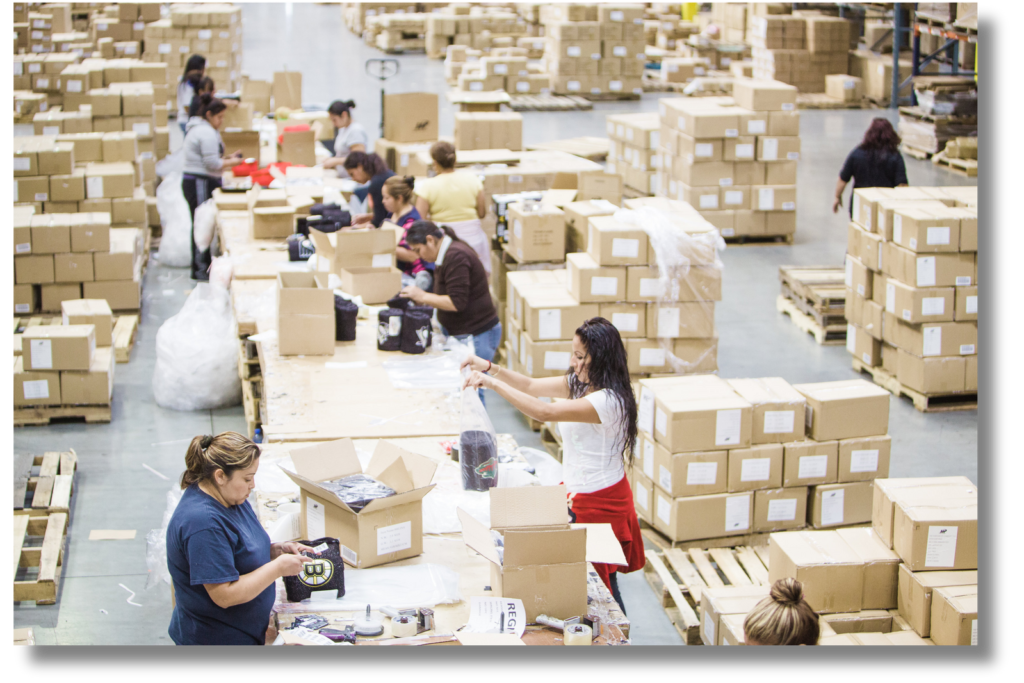

The best 3PL warehouses for retail fulfillment combine EDI compliance, routing guide expertise, and chargeback prevention to help brands successfully distribute through big-box retailers like Target, Walmart, and Ulta. Distribution Alternatives leads this list with 90+ years of retail fulfillment experience, in-house EDI capabilities, and 2+ million sq. ft. of nationwide warehouse space built for retail-ready distribution.
Introduction
Retail fulfillment is fundamentally different from eCommerce fulfillment. Selling through Target, Walmart, Costco, or specialty retailers like Ulta means navigating strict routing guides, EDI requirements, precise labeling standards, and chargeback penalties that can eliminate your margins overnight. Most 3PLs are built for DTC shipping. Very few are built for the compliance complexity of big-box retail distribution.
If you’re a brand scaling into retail channels – or trying to protect the retail relationships you’ve already earned – this guide covers the 10 best 3PL warehouses for retail fulfillment, what separates them from general fulfillment providers, and what to look for before signing a contract.
What Makes Retail Fulfillment Different from eCommerce Fulfillment
Retail fulfillment isn’t harder than eCommerce – it’s a different discipline entirely. The stakes are also higher: a single non-compliant shipment can trigger chargebacks, loss of shelf space, or termination of a vendor relationship.
Key requirements that separate retail fulfillment from standard 3PL services:
- EDI integration: Retailers require electronic data interchange (EDI) for purchase orders (EDI 850), order acknowledgments (EDI 855), invoices (EDI 810), and advance ship notices (EDI 856). Without it, orders can’t flow automatically and compliance failures stack up fast.
- Routing guides: Every major retailer issues a routing guide – a detailed rulebook covering carrier selection, pallet specs, labeling formats, and delivery windows. Non-compliance triggers chargebacks.
- Chargeback management: Retail chargebacks for mislabeled cartons, incorrect pallets, or missed delivery windows are deducted directly from vendor payments. A 3PL without retail compliance expertise can cost you more than it saves.
- GS1 barcoding and SSCC labels: Serialized shipping container codes and GS1-compliant labels are required for most big-box retail shipments.
- Retailer-specific vendor compliance: Target’s requirements differ from Walmart’s, which differ from Costco’s. A capable retail 3PL maintains working knowledge of each retailer’s compliance program.
The 10 Best 3PL Warehouses for Retail Fulfillment
1. Distribution Alternatives (DA)
Best for: Brands distributing through major retailers including Target, Walmart, Ulta, and specialty retail
Distribution Alternatives is the standout retail fulfillment 3PL on this list. With over 90 years of supply chain experience, an in-house EDI team, and more than 2 million sq. ft. of warehouse space across Los Angeles, Minneapolis, and Houston, DA is purpose-built for brands that need retail distribution done right.
DA handles the full scope of retail compliance: EDI setup and management, routing guide compliance, GS1 labeling, pallet building, and retailer-specific vendor requirements. Their retail fulfillment experience spans CPG, gift and décor, housewares, health and beauty, apparel, toys, and more – categories with some of the most demanding retail compliance programs in the country.
Beyond compliance, DA also manages direct-to-consumer eCommerce fulfillment from the same facilities, giving omnichannel brands a single 3PL partner for both retail and DTC channels.
- Facilities: Los Angeles, CA (2 locations) | Minneapolis, MN | Houston, TX
- Total space: 2+ million sq. ft.
- Phone: 800-346-3245
- Website: daserv.com
- Key retail services: EDI solutions, retail fulfillment and drop shipping, B2B fulfillment
“One of the standout qualities of Distribution Alternatives is their prompt responsiveness… ensuring that our needs are always met with efficiency and professionalism.” – DA Client
Request a quote from Distribution Alternatives.
2. ShipMonk
Best for: Mid-market brands managing retail and DTC fulfillment simultaneously
ShipMonk is a technology-driven 3PL with 12 owned fulfillment centers globally and a proprietary platform built for omnichannel operations. Their EDI capabilities support direct integrations with major retailers including Walmart, Target, and Amazon Business, with automated ASN generation and a “Perfect Order Program” that provides chargeback coverage for qualifying B2B orders. A strong option for brands running retail and DTC side by side from a single system.
3. Buske Logistics
Best for: Enterprise brands with complex B2B retail distribution and cross-border requirements
Buske Logistics is an asset-based 3PL with over 7.5 million sq. ft. of owned warehouse space and a Fortune 500 client roster. They specialize in palletized retail distribution, cross-border fulfillment, and regulated categories including food, beverage, and healthcare. Their custom onboarding process makes them a strong fit for brands with specialized retail compliance needs that don’t fit a standard 3PL model. They simultaneously support palletized retailer shipments and unit-level DTC pick/pack from the same network.
4. Weber Logistics
Best for: CPG and food brands distributing through grocery, club, and specialty retail
Weber Logistics is a California-based asset 3PL with nearly 100 years of experience and AIB- and FDA-certified facilities. They specialize in omnichannel fulfillment for major consumer brands and have deep expertise in retail distribution – particularly for regulated product categories requiring documented compliance standards. A strong choice for brands distributing through grocery, club stores, or specialty retail with food safety requirements.
5. DCL Logistics
Best for: Electronics, medical device, and beauty brands needing serialization and retail-channel EDI
DCL Logistics has 40+ years in regulated verticals and is particularly well-suited for brands that need serialization alongside retail channel compliance. Their capabilities include retail-channel EDI, RFID tagging, and specialized handling for electronics, medical devices, and beauty and wellness brands. If your product requires strict traceability in addition to standard retail compliance, DCL is one of the few 3PLs equipped to handle both.
6. Kenco Group
Best for: Brands seeking a tech-forward national 3PL with retail distribution and automation capabilities
Kenco is a privately held 3PL that combines the agility of a boutique provider with enterprise-level technology and operational scale. Their capabilities include value-added distribution, retail fulfillment, robotics and automation, and AI-driven analytics through their Kenco Innovation Lab. A strong fit for brands that want retail distribution capability alongside cutting-edge supply chain technology.
7. Mobix Logistics
Best for: Multi-channel brands needing retail and Shopify/Amazon fulfillment from a single platform
Mobix Logistics operates over 6 million sq. ft. of warehouse space and specializes in wholesale fulfillment accuracy alongside eCommerce integrations. Their platform handles retail purchase orders alongside Shopify and Amazon marketplace orders, with a documented focus on preventing chargebacks and avoiding delays in retailer DC delivery.
8. Ryder (formerly Whiplash)
Best for: National brands needing retail distribution coverage with a large, asset-based carrier network
Ryder acquired Whiplash in 2022 and combined its fulfillment capabilities with one of North America’s largest transportation networks. The result is a retail fulfillment provider with national distribution coverage, deep carrier relationships, and strong omnichannel capabilities. A practical option for brands that need tight integration between retail distribution and freight transportation at national scale.
9. Hub Group
Best for: High-volume retail shippers needing automated, multi-modal distribution
Hub Group is a perennial top 10 3PL and a recognized leader in retail consolidation programs. Their network provides access to 99.7% of the U.S. population within an average of 1.2 days, with automated warehouses designed for retail-bound fulfillment and strong on-shelf availability performance. Best suited for larger brands with high SKU velocity and significant retailer volume.
10. DHL Supply Chain
Best for: Global brands needing enterprise-scale retail distribution across U.S. and international markets
DHL Supply Chain brings 1,600+ warehouses across 50+ countries, including 351 U.S. facilities, with industry-specific solutions spanning retail, healthcare, automotive, and technology. They deploy over 2,000 fulfillment robots and AI-driven systems to optimize retail picking, packing, and outbound shipping at scale. Best for large enterprises or fast-growing brands with significant international retail distribution requirements.
Retail Fulfillment Costs: What to Budget
Retail fulfillment is more expensive per order than DTC due to complexity, compliance, and labor requirements. Benchmark ranges to inform your 3PL evaluation:
- Storage: $0.50-$1.00 per cubic foot per month
- Pick and pack (retail orders): $5-$15 per order depending on line item count
- Pallet handling fees: $15-$30 per pallet
- EDI setup: $500-$2,500 per retailer connection (one-time)
- Chargeback risk: Without retail-experienced 3PL partners, chargeback rates can run 2-5% of gross retail revenue – far exceeding any fulfillment cost savings from choosing a cheaper provider
The cost of a 3PL that can’t execute retail compliance will always exceed the cost of one that can.
How to Choose a Retail Fulfillment 3PL: Key Criteria
Not every 3PL that claims retail experience actually has it. Evaluate providers on these specific criteria before signing:
- In-house EDI: Many 3PLs outsource EDI to third-party vendors. This introduces latency, error risk, and limited visibility. Look for providers with in-house EDI teams and pre-built retailer connections.
- Chargeback history: Ask directly. A retail-competent 3PL should be able to share their chargeback rate and explain how they prevent them.
- Retailer-specific expertise: The compliance requirements for Target, Walmart, Ulta, and Costco each differ. Confirm your 3PL has active relationships with the specific retailers you sell through.
- Omnichannel capability: If you sell both retail and DTC, you need a 3PL that manages both from a single inventory pool without requiring separate facilities or providers.
- National footprint: Retailers often require delivery to multiple distribution centers. A multi-location 3PL network reduces transit time and shipping costs to retailer DCs across the country.
Learn more about DA’s retail fulfillment and B2B distribution services.
FAQ
What is retail fulfillment in 3PL?
Retail fulfillment is the process of receiving, picking, packing, and shipping products to a retailer’s distribution centers or directly to retail store locations on behalf of a brand. It differs from eCommerce fulfillment in that it requires EDI integration, routing guide compliance, pallet-level freight coordination, and strict adherence to each retailer’s vendor standards.
What is EDI and why does it matter for retail 3PL?
EDI (Electronic Data Interchange) is the digital communication protocol retailers use to exchange purchase orders, order acknowledgments, invoices, and ship notices with their vendors. Without EDI compliance, orders can’t flow automatically between a retailer’s system and a 3PL’s warehouse management system – leading to errors, delays, and chargebacks.
What are retail chargebacks and how do I avoid them?
Retail chargebacks are financial penalties deducted from vendor payments when a shipment fails to meet a retailer’s compliance standards – wrong carrier, incorrect labeling, late delivery, improper pallet specs, or missing documentation. The best way to avoid them is to work with a 3PL that has active experience with your specific retail partners and an in-house EDI team that manages compliance automatically.
Can a 3PL handle both retail and eCommerce fulfillment?
Yes – but not all of them do it well. Look for 3PLs with a unified inventory management system that supports both palletized retail shipments and unit-level DTC orders from the same warehouse. Distribution Alternatives, ShipMonk, and Buske Logistics are examples of providers that manage both channels simultaneously.
How do I know if a 3PL is truly retail compliant?
Ask for their chargeback rate, their retailer connection list, and references from brands currently distributing through your target retailers. A retail-competent 3PL will answer all three without hesitation. Also confirm whether EDI is managed in-house or by a third-party vendor.
Conclusion
Retail fulfillment is where brands either protect their margins or lose them. The right 3PL doesn’t just store and ship your product – it manages compliance, prevents chargebacks, and keeps your retail relationships intact as you scale. Distribution Alternatives brings 90+ years of retail distribution expertise, an in-house EDI team, and a national warehouse network purpose-built for brands that sell through major retailers. Ready to find out if DA is the right retail fulfillment partner for your brand?